AI as Extension, Not Replacement: Why Students’ Cultural Understanding of AI Matters
There is a quiet cultural shift happening in our classrooms.
Students are not only discovering AI as a way to complete work faster. Many are beginning to understand AI as something more personal and immediate: a tutor, a helper, a second explanation, a place to go when something has not quite landed.
That matters.
In conversations with students, especially younger secondary students, AI is often described less as a cheating machine and more as a gap-filler. They use it when they do not understand a concept. They use it when they need an explanation in simpler language. They use it when they want feedback before submitting something. They use it when they are unsure where to begin.
This does not mean all AI use is appropriate. It absolutely is not. But it does mean that the way students are culturally constructing AI should make us pause before responding only with prohibition.
Because when students see AI as a way to fill gaps in their learning, and teachers respond by simply saying “do not use it”, students may hear something quite different from what we intend. They may hear: “Do not use the tool that helps you understand.” Worse, they may feel that adults are blocking access to a form of support they believe should already have been available through teaching, feedback, pacing, clarification or individual help.
That is a risky cultural position for schools to occupy.
The issue is not whether teachers are working hard enough. Teachers are. The issue is that classrooms are complex, time is limited, students learn unevenly, and no single explanation lands equally for every learner. Gaps emerge. They always have. What has changed is that students now have an always-available tool that appears to respond directly to those gaps.
So the question cannot only be: How do we stop students using AI?
A more useful question is: How do we teach students the difference between using AI to replace their thinking and using AI to extend it?
That distinction — AI replacement vs AI extension — may be one of the most practical frameworks we can offer students.
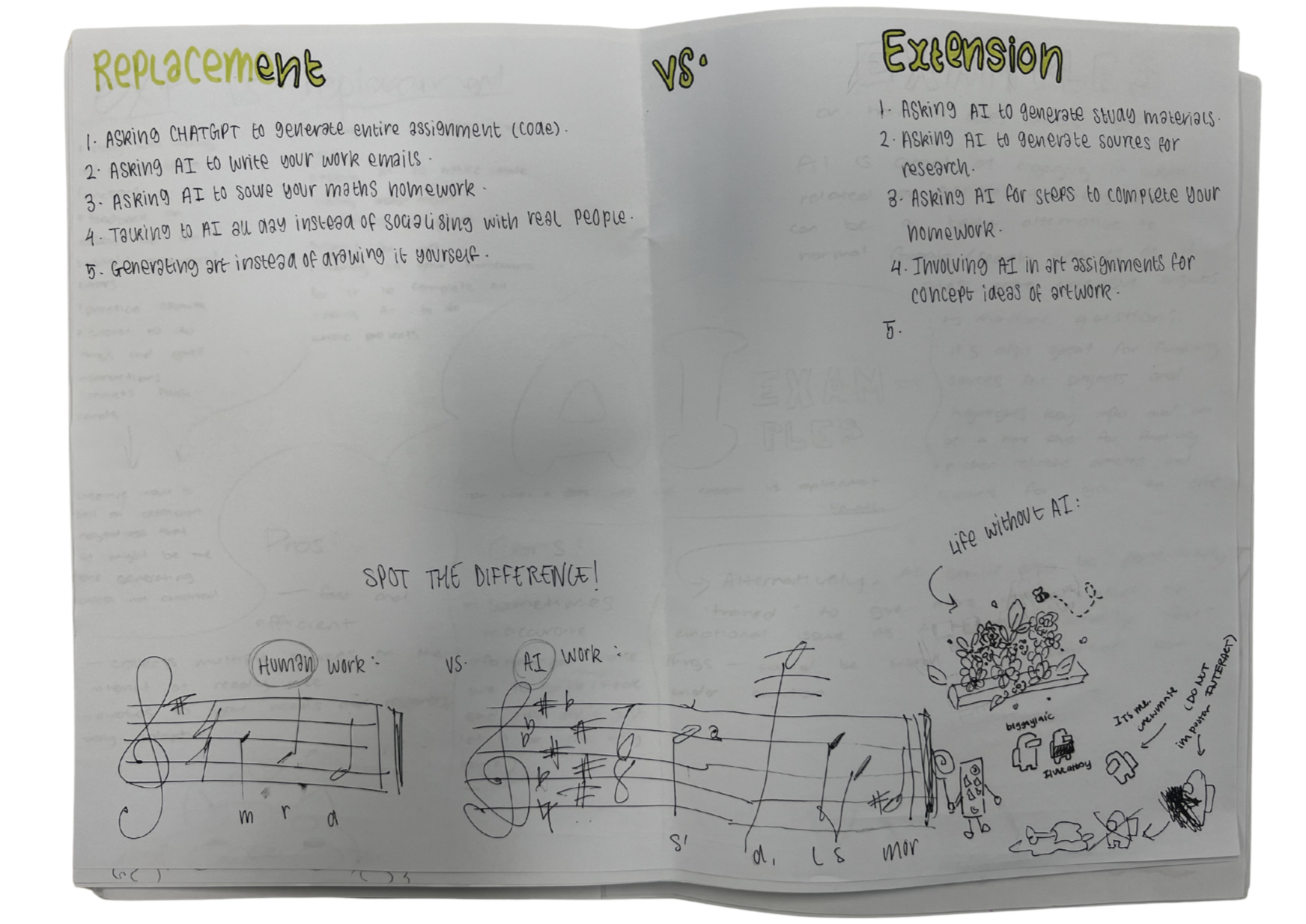
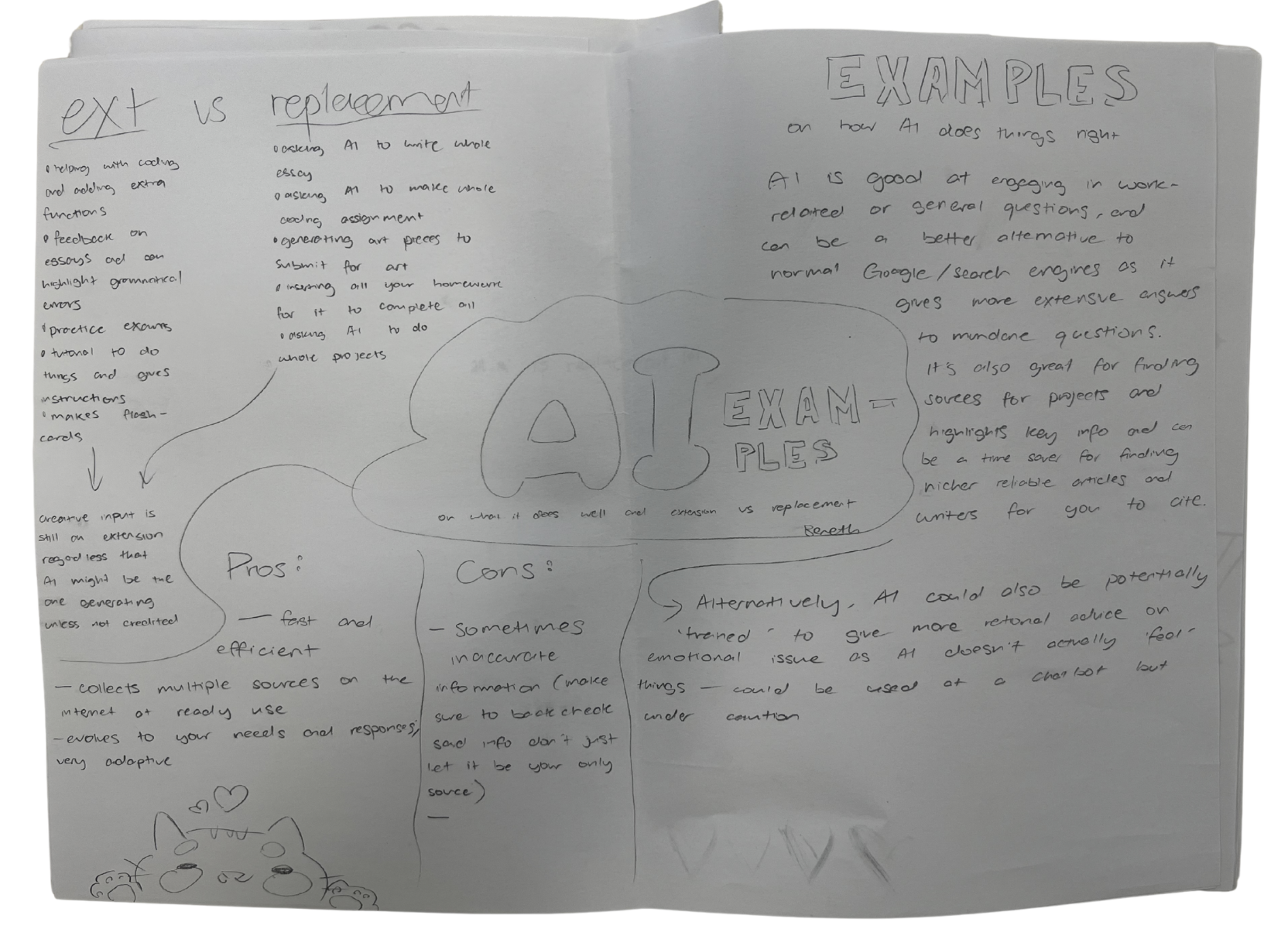
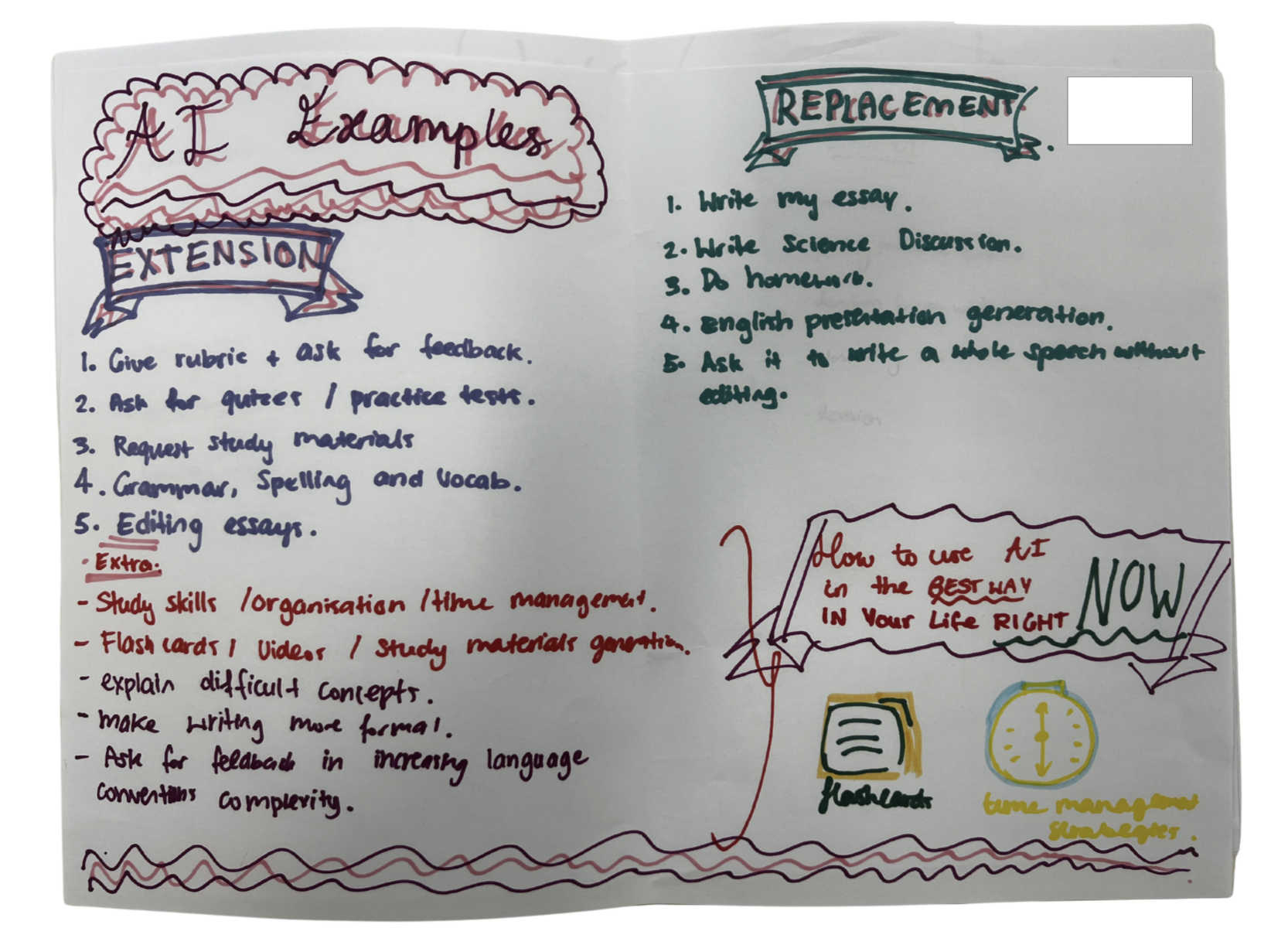
In a recent Year 9 activity, students were asked to explore this exact distinction. Their responses were surprisingly clear and mature. They identified replacement as asking AI to write an essay, complete homework, generate a whole speech, finish a worksheet, do a maths problem, or create work that is submitted unchanged. But they also identified extension as using AI to generate practice quizzes, create flashcards, give feedback, explain difficult concepts, support grammar and vocabulary, organise study, check work against a rubric, or help improve a draft. Across the pages of their work, the students repeatedly returned to the same basic distinction: AI becomes problematic when it does the learning for you; it becomes productive when it helps you do the learning better.
That is a powerful educational insight.
Replacement hides learning. Extension reveals it.
AI replacement is when the student disappears.
The tool produces the answer, the essay, the speech, the solution, the artwork or the analysis, and the student becomes a courier. They carry the finished product from the machine to the teacher. The work may look polished, but the learning is hollow. There is no struggle, no ownership, no intellectual risk, no evidence of growth.
Replacement sounds like:
“Write my essay for me.”
“Do my homework.”
“Answer this worksheet.”
“Generate my whole speech.”
“Create a response I can memorise.”
“Make this sound sophisticated even though I do not understand it.”
This is not learning. It is outsourcing.
AI extension is different. Extension keeps the student in the centre. The student still thinks, chooses, drafts, checks, revises, explains and owns the work. AI becomes a support for learning, not a substitute for it.
Extension sounds like:
“Explain this concept in simpler language.”
“Give me three practice questions on this topic.”
“Quiz me on the key ideas.”
“Give me feedback on my draft, but do not rewrite it.”
“Check whether my paragraph answers the rubric.”
“Help me understand where my reasoning is weak.”
“Give me a study plan for tomorrow’s test.”
“Turn my notes into flashcards.”
“Explain this in a different way.”
This is where AI has genuine educational potential. It can support metacognition, feedback-seeking, revision, independent learning and confidence. For gifted learners, it can help extend inquiry, generate alternative perspectives and push complexity. For students who are struggling, it can provide another explanation, another pathway, another chance to understand.
The danger is that if schools only frame AI as a threat, we may lose the chance to teach this distinction properly.
The cultural problem with blanket pushback
When teachers oppose AI use without nuance, the message may feel clear to us: “Do not plagiarise.”
But that is not always what students hear.
Students who are using AI to fill gaps in understanding may hear: “Do not seek help there.”
Students who feel embarrassed asking questions in class may hear: “Stay confused.”
Students who missed the first explanation may hear: “You should already know this.”
Students who are trying to revise independently may hear: “Your way of learning is not valid.”
This does not mean we excuse academic dishonesty. We should not. Presenting AI-generated work as one’s own is a serious breach of integrity. But if our only response is punitive, we risk pushing AI use underground. Students will still use it, but with less honesty, less guidance and less chance of developing discernment.
That is the worst possible outcome.
A better response is to teach students that AI use sits on a spectrum. Some uses are clearly inappropriate. Some are clearly productive. Some depend on the task, the timing, the teacher’s instructions and whether the student is transparent.
We need to make that visible.
What this looks like for everyday students
Students need simple, repeated, concrete examples.
Not a vague lecture about “ethical AI”. Not a policy buried in a handbook. Not only a warning about plagiarism. They need classroom language they can actually use.
A practical framework might look like this:
AI replacementAI extension“Write my essay.”“Give me feedback on my essay structure.”“Do my maths homework.”“Explain the steps in a similar example.”“Answer this worksheet.”“Quiz me on the concepts before I answer.”“Generate my whole speech.”“Suggest ways I could make my own speech clearer.”“Rewrite this so it sounds smart.”“Highlight unclear sentences and explain why they are unclear.”“Create my assignment response.”“Help me understand the task instructions.”“Give me something to memorise.”“Ask me questions so I can test my understanding.”
The key question for students is beautifully simple:
Is AI replacing my thinking, or extending it?
That question can travel across subjects.
In English, extension might mean asking AI to identify whether a paragraph has a clear topic sentence, evidence and explanation. Replacement would be asking it to write the paragraph.
In Science, extension might mean asking AI to explain a concept like photosynthesis, forces or chemical reactions in simpler terms. Replacement would be asking it to write the prac report.
In HASS, extension might mean asking AI to quiz the student on causes and consequences before they write. Replacement would be asking it to produce the historical analysis.
In Maths, extension might mean asking AI to explain the steps in a similar problem. Replacement would be asking it to solve the exact problem for submission.
In Languages, extension might mean asking AI to explain a grammar pattern. Replacement would be translating the whole task and submitting it as personal work.
In the Arts, extension might mean brainstorming visual concepts or reflecting on artistic choices. Replacement would be generating the final artwork without meaningful student input.
This is teachable. But it has to be explicit.
The teacher’s role becomes more important, not less
There is a fear that AI will make teachers less necessary. I think the opposite is more likely.
AI makes teacher judgment more important.
Students need adults who can help them understand when a tool is helping them learn and when it is quietly removing them from the learning process. They need teachers to design tasks where thinking is visible: drafts, annotations, conferences, oral explanations, process journals, reflections, version histories, peer critique and justification of choices.
They also need teachers to model good AI use.
We can show students how to ask better questions. How to check for errors. How to compare AI feedback with a rubric. How to reject weak suggestions. How to acknowledge assistance. How to keep their own voice. How to use AI when stuck without surrendering ownership.
In that sense, AI is not just a technology issue. It is a pedagogy issue.
It asks us to reconsider what we value in assessment. If a polished final product can be generated quickly, then the evidence of learning may need to shift toward process, reasoning, reflection, oral defence, iteration and transfer. We may need to assess not only what students produce, but how they got there and whether they can explain, adapt and apply their understanding.
A positive way forward
Schools do need clear boundaries around AI. Students should know that submitting AI-generated work as their own is plagiarism. They should know that memorising an AI response for an assessment is not evidence of genuine learning. They should know that dishonesty has consequences.
But boundaries alone are not enough.
We also need a positive learning culture around AI. One that says:
Use AI to practise, not to pretend.
Use AI to clarify, not to copy.
Use AI to strengthen your thinking, not to hide the absence of it.
Use AI as a tutor, not as a ghostwriter.
Use AI to extend your learning, not replace it.
The cultural development is already underway. Students are already forming beliefs about what AI is for. If we do not help shape those beliefs, they will be shaped elsewhere: by peers, platforms, convenience and pressure.
Our task is not to stand in front of the tide and tell it to stop. Our task is to teach students how to swim with intelligence, integrity and courage.
The most useful question may not be “Did you use AI?”
It may be:
Did AI help you think more deeply, or did it think for you?
