Elevating Student Voice Through Whole-School Collaboration
AITSL Focus Areas: Meet professional ethics and responsibilities (7.1); Evaluate and improve teaching programs (3.6)
Situation
In 2022, I was approached by my school’s Associate Principal for Teaching and Learning to assist in developing a staff-facing video that would catalyse a whole-school conversation about Student Voice. Our school was navigating significant leadership change and reimagining itself as a learning community grounded in student partnership and authentic engagement.
While the school’s 2020–2024 Business Plan referenced student voice through wellbeing surveys, the current executive team sought a more active, embedded approach—one that placed students at the centre of teaching and learning.
This work was aligned with Teaching for Impact principles that view students not as passive recipients but as co-agents in their learning journey. As Gonski et al. (2018) argue, partnering with students promotes agency, engagement, and wellbeing. Hattie (2009) reinforces this by showing that student achievement accelerates when learners take responsibility for their own learning, and teachers become learners of their own impact.
Our goal was to shift from consultation to collaboration, allowing student perspectives to shape pedagogy and drive school improvement—ultimately fostering classroom environments where all learners feel heard, respected, and empowered.
Action
The initial film project became a springboard for deeper school-wide initiatives. My contribution unfolded in three phases:
Film Production
I planned, filmed, and edited a 10-minute documentary-style video featuring student interviews that explored questions such as:How do you currently participate in your learning?
What makes learning engaging and meaningful?
What does good teaching look like to you?
The planning and filming took one week of pre-production, three days of shooting, and three days of post-production. This was done in collaboration with my associate principal, modelling the collaborative professionalism promoted by AITSL.
Professional Learning Facilitation
At two separate professional development days, I led staff workshops (40 minutes each) involving approx. 15 colleagues. In these sessions, I shared the film, facilitated structured reflections, and posed design-thinking prompts for co-creating student-teacher learning partnerships.I used the Double Diamond model to guide teachers through divergent thinking (gathering student ideas) and convergent thinking (developing classroom applications). This linked directly with Teaching for Impact’s goal to improve teaching effectiveness by better understanding learners.
Ongoing Leadership in Student Voice
Since then, I’ve become involved in further initiatives including:Contributing to additional films commissioned by the Quality Teaching Services unit.
Supporting staff inquiry projects around student voice implementation.
Embedding student voice frameworks in my own classroom (see Evidence Set 002).
These actions demonstrate sustained engagement in leading change, improving practice, and contributing to a culture of evidence-informed reflection.
Outcome
This work deeply transformed my professional identity. It confirmed for me that teaching is most powerful when we operate in partnership with our students. Key insights from the student interviews included:
Learner diversity must be met with pedagogical diversity.
Autonomy, trust, and scaffolding are not mutually exclusive.
Students want teachers who guide, not dictate—coaches rather than commanders.
Relationships are the foundation of learning.
I brought these principles into my own teaching, intentionally designing co-constructed learning experiences that honour student agency and voice. This contributed to a shift in classroom culture, where students are more self-directed, motivated, and reflective.
At the whole-school level, the initial film is now used during induction for new staff and featured in leadership planning documents—evidence of its sustained impact. Through this project, I have helped shape a more inclusive, dynamic learning culture that aligns with AITSL’s vision for high-impact, learner-centred teaching.
Annotated Evidence
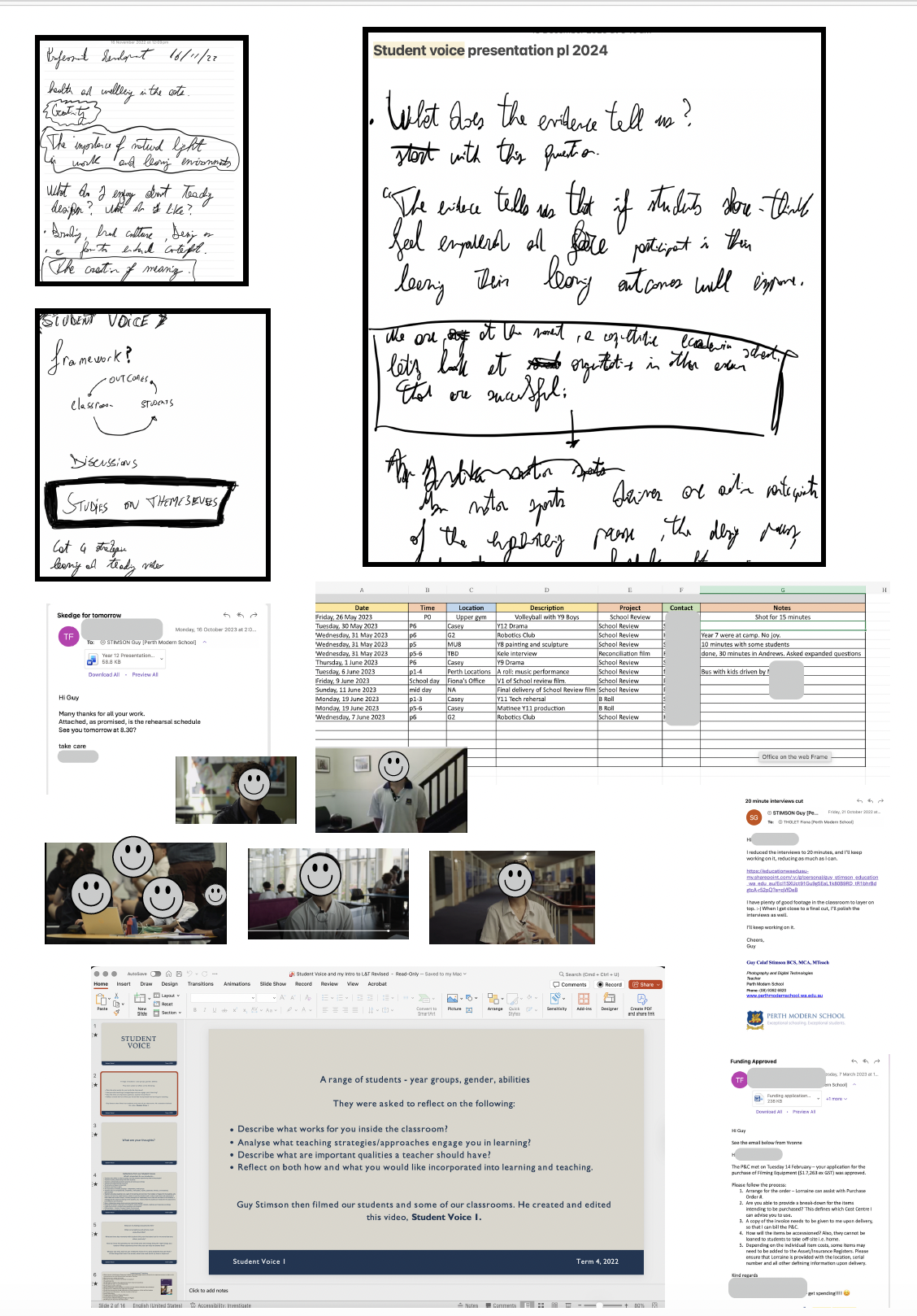
3.6 Evaluating and Improving Teaching Programs Through School-Wide Student Voice Work
The Student Voice video project gave me a uniquely comprehensive lens through which to evaluate teaching and learning programs across Perth Modern School. Coordinating with my Associate Principal to select classrooms and learning activities meant examining curriculum enactment, teacher practice, and lesson design across multiple faculties. This process allowed me to see how different programs were structured, how teachers sequenced learning, and how students experienced those choices in real time. As I filmed lessons, observed pedagogical moves, and documented classroom interactions, I gathered rich, authentic evidence that extended far beyond my own subject area.
The students’ reflections on these lessons became a critical evaluative tool. Their commentary—captured in interviews and workshop notes—acted as a feedback loop revealing which strategies supported engagement, autonomy, clarity, and deeper thinking. Hearing students articulate what helped them learn, what confused them, and what motivated them provided direct insight into program effectiveness and areas for refinement. This evidence significantly informed my own planning, helping me adjust sequencing, scaffolding, and the balance between structure and independence in my teaching.
The extended duration of the project—spanning planning, classroom observation, filming, editing, and staff presentations—consolidated my understanding of a wide spectrum of teaching across the school. It enabled me to evaluate programs through multiple sources of evidence: classroom footage, student perspectives, curriculum documents referenced during filming, and the pedagogical intentions shared by colleagues. This multi-layered evaluative process strengthened my ability to review teaching programs critically and systematically, and the insights gained continue to shape the way I design, refine, and improve my own programs in response to evidence.
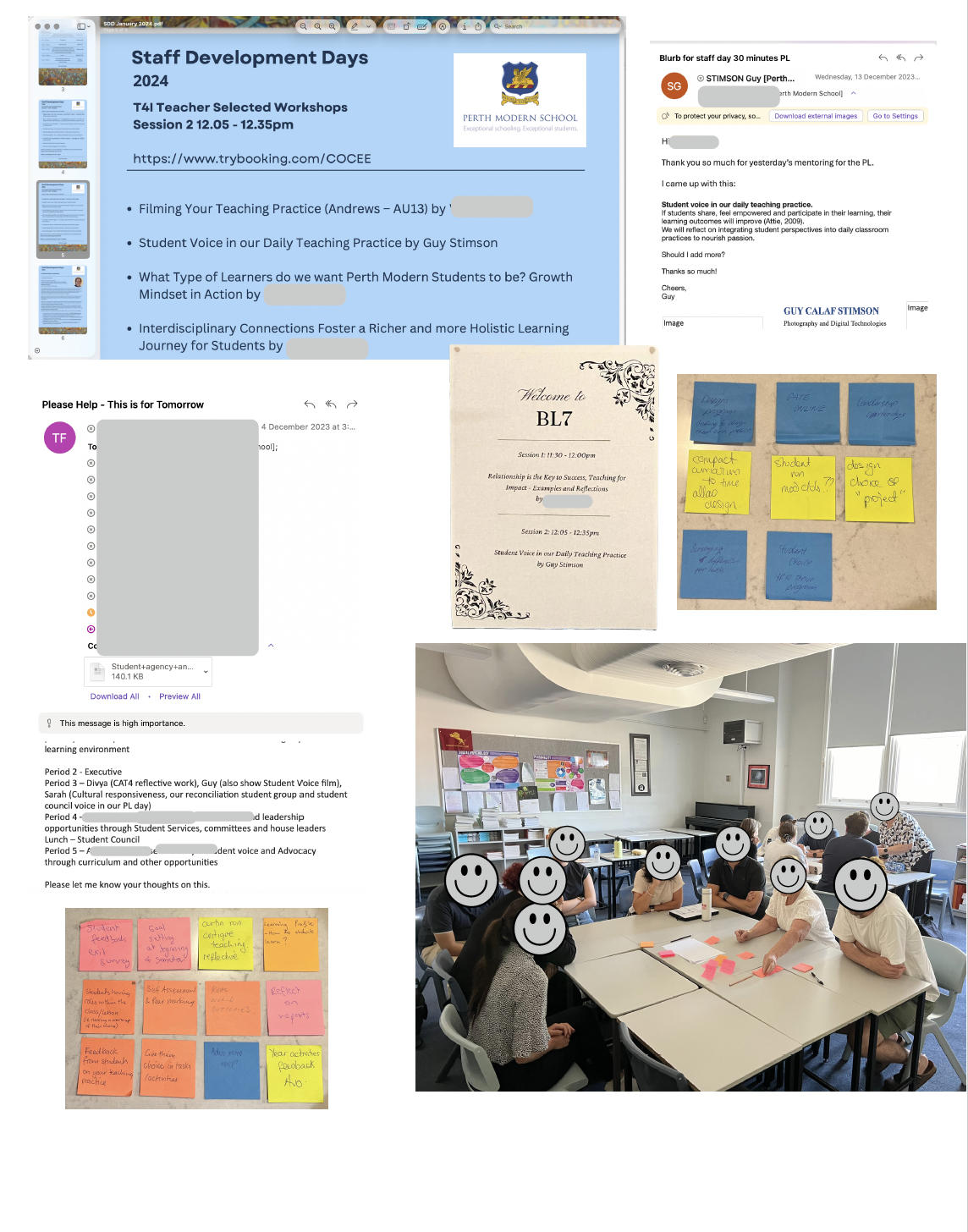
7.1 Meeting Professional Ethics and Responsibilities Through the Design and Delivery of a Whole-School Professional Learning Session
This collection of planning documents, emails, staff development materials, workshop artefacts, and photographs demonstrates my commitment to meeting the ethical standards and professional responsibilities expected of teachers at Perth Modern School. In preparing and delivering a voluntary professional learning session on Student Voice and classroom practice, I took deliberate steps to ensure that my work aligned with the codes of conduct governing confidentiality, respectful collaboration, and responsible engagement with colleagues.
Before constructing the session, I carefully reviewed the school’s policies, Teaching for Impact documentation, and the Department of Education’s ethical guidelines to ensure the material I presented upheld professional expectations. This included securing permission for all classroom footage, managing sensitive student commentary appropriately, anonymising materials where required, and ensuring that the experiences shared by colleagues were represented accurately and respectfully. The emails and planning correspondences reflect this ethical diligence: I consulted my Associate Principal, clarified the purpose and scope of the session, sought feedback, and ensured transparency around how staff contributions and student perspectives would be used.
In designing the workshop, I exercised professional judgement to present student voice insights in a way that supported—not evaluated or criticised—my colleagues’ practice. The post-it note activities, reflective prompts, and structured collaborative tasks were chosen to create a safe, collegial environment where staff could explore pedagogy without feeling scrutinised. This aligns directly with 7.1’s expectation that teachers model integrity, respect, and responsibility in all professional interactions.
Delivering the session to staff from across the school further required ethical awareness. I ensured that the discussion centred on shared learning, improvement, and collective responsibility rather than individual performance. The workshop upheld principles of confidentiality, professional respect, and psychological safety—allowing colleagues to reflect openly on their teaching practice while trusting that their contributions would be handled with care.
By grounding the entire process in ethical decision-making, transparent communication, and respect for colleagues’ professionalism, I demonstrated the behaviours expected under AITSL Focus Area 7.1. This session did not simply transmit knowledge; it modelled the ethical culture required for meaningful, sustainable school improvement.