Reimagining Subject Selection for Informed, Student-Centred Pathways
AITSL Focus Areas: Interpret student data (5.4); Engage with Parents/caregivers (7.3)
Situation
In 2023, my second year at Perth Modern School, I participated in the Subject Selection Online (SSO) event by presenting the Year 11 ATAR Design course to the outgoing Year 10 cohort. This experience marked the beginning of a deeper reflection on the role of SSO—not simply as a promotional opportunity, but as a moment to support student agency, informed decision-making, and the integrity of learning pathways.
As I became more involved in the process, I began to reflect critically on the tone and intent of the current format. I came to feel that its promotional nature may be somewhat misaligned with what I see as a core responsibility of educators: fostering a culture of trust in our students’ ability to make thoughtful, self-directed choices. This is particularly relevant in an academically selective environment, where students are often highly invested in their personal and academic development. Following a recent Learning Area meeting, I shared this view with colleagues as part of an ongoing conversation about how we might better support student agency and long-term engagement.
Grounded in the philosophy of Sir Ken Robinson, I believe education should help students discover their element—the intersection of passion and aptitude. In this spirit, subject selection should not be framed as a pitch, but as a process of guided insight. Particularly in the case of ATAR Design—a two-year journey that contributes directly to students’ final results—supporting students to make authentic, well-informed decisions is essential.
Action
My contribution to the evolution of SSO at our school has taken place across three years and includes a sequence of collaborative, strategic, and community-oriented actions:
Initial Presentation and Critical Reflection (2023)
In my second year at Perth Modern School, I delivered my first Subject Selection Online presentation for the Year 11 ATAR Design course. This prompted a personal and professional re-evaluation of SSO’s potential—from a marketing exercise to a touchpoint for meaningful student reflection and guided autonomy.Unified Learning Area Identity: Creativity (2024)
In 2024, through a series of planning conversations with my second-in-charge and Head of Learning Area, we developed a unifying message for the Arts and Technologies Learning Area: creativity. As part of this shift, I contributed to a hand-scribed explainer video highlighting the distinctiveness of each subject, while communicating our shared values. This marked an important move toward holistic, student-focused communication.Agile Response and Reflection (2025)
In 2025, with limited lead time for the SSO event, I worked closely with my subject partner to contribute to a shared Canva-based presentation for the learning area. While efficient, the format reinforced my belief that meaningful engagement cannot be built around slides alone. This experience reaffirmed the importance of offering students authentic, lived insights into subject culture and expectations.Subject as Community: Culture by Design
Rather than promoting the subject, my colleague and I have focused on building a culture that students want to be part of. From Year 7 to Year 12, Photography and Design is structured as a community of practice. Year 10 students participate in shared critiques and creative workshops with senior students, creating a natural progression toward ATAR Design. Our approach is based on a philosophy of open invitation: once students are fully informed of the expectations and opportunities within the subject, we trust them to choose whether to join the community. We focus not on convincing, but on welcoming.Vision for the Future: From Event to Experience (2026 and Beyond)
We are currently developing a redesigned SSO experience for 2026. In collaboration with my second-in-charge, we are planning a hands-on workshop hosted in our classroom, introduced by design staff from Murdoch University and followed by a showcase of Year 12 ATAR Design projects. This immersive event will allow Year 10 students to:Engage in creative problem-solving;
Connect with peers and tertiary mentors;
Experience the values and expectations of the senior course in a real and embodied way.
Parent Engagement and Clarity of Communication
These reflections have also led me to rethink how we communicate with families. I am currently developing a small booklet for use during parent-teacher meetings that outlines the benefits of being part of the Photography and Design learning community—highlighting creativity, project-based learning, and the development of transferable skills through design thinking. Additionally, I am planning to embed these key ideas in welcome emails to parents and caregivers at the start of each semester, helping to align our classroom culture with family expectations and support structures from the outset.
Outcome
Through this work, subject selection has shifted from a presentation task to an opportunity for long-term educational design and innovation. My evolving approach has brought together classroom practice, faculty collaboration, and parent communication into a more cohesive and principled vision.
Key outcomes include:
Increased student clarity and ownership of subject selection decisions, particularly for ATAR Design;
Strengthened culture and continuity across year levels through shared projects and mentorship;
Shared identity across the learning area, built around creativity and authentic engagement;
Improved communication with families, both at transition points and in day-to-day messaging;
A clear plan for 2026 and beyond, positioning subject selection as a reflective and participatory experience rather than a promotional one.
This evidence set demonstrates my ongoing commitment to student agency, curriculum culture, and collaborative leadership. By anchoring SSO in authenticity and trust, I hope to continue shaping an environment where students feel supported not just in choosing a subject, but in becoming part of a creative and purposeful learning community.
Annotated Evidence
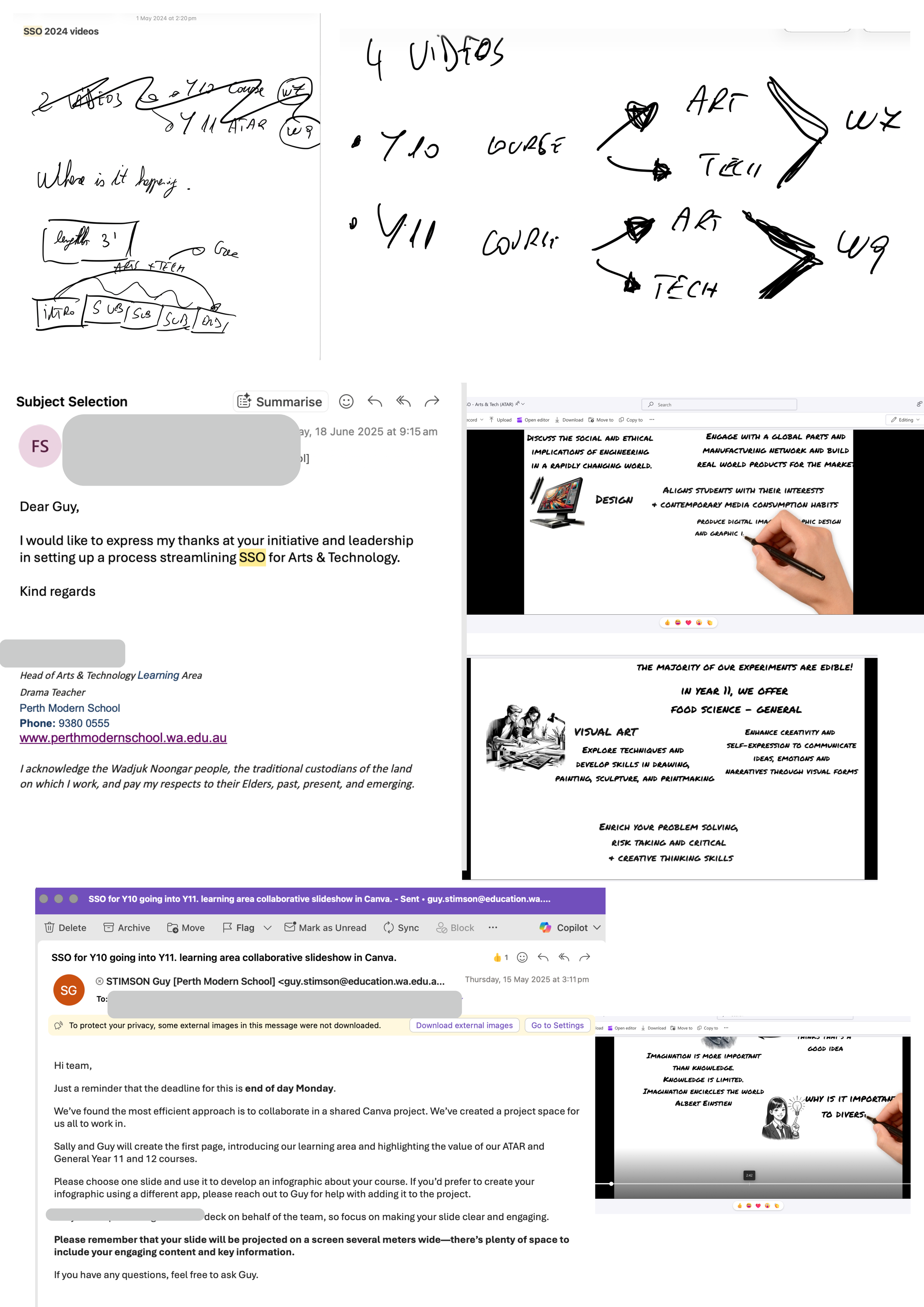
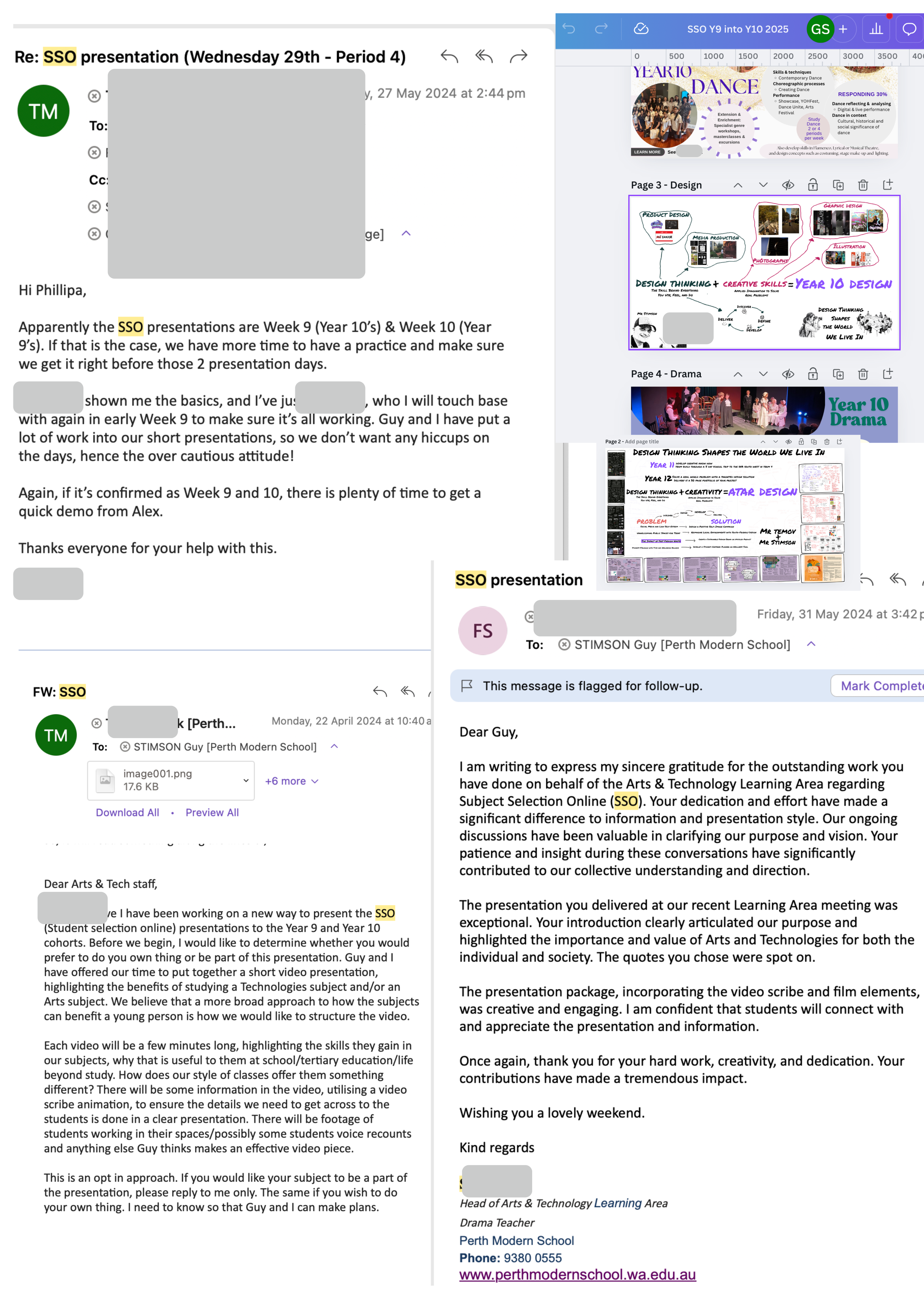
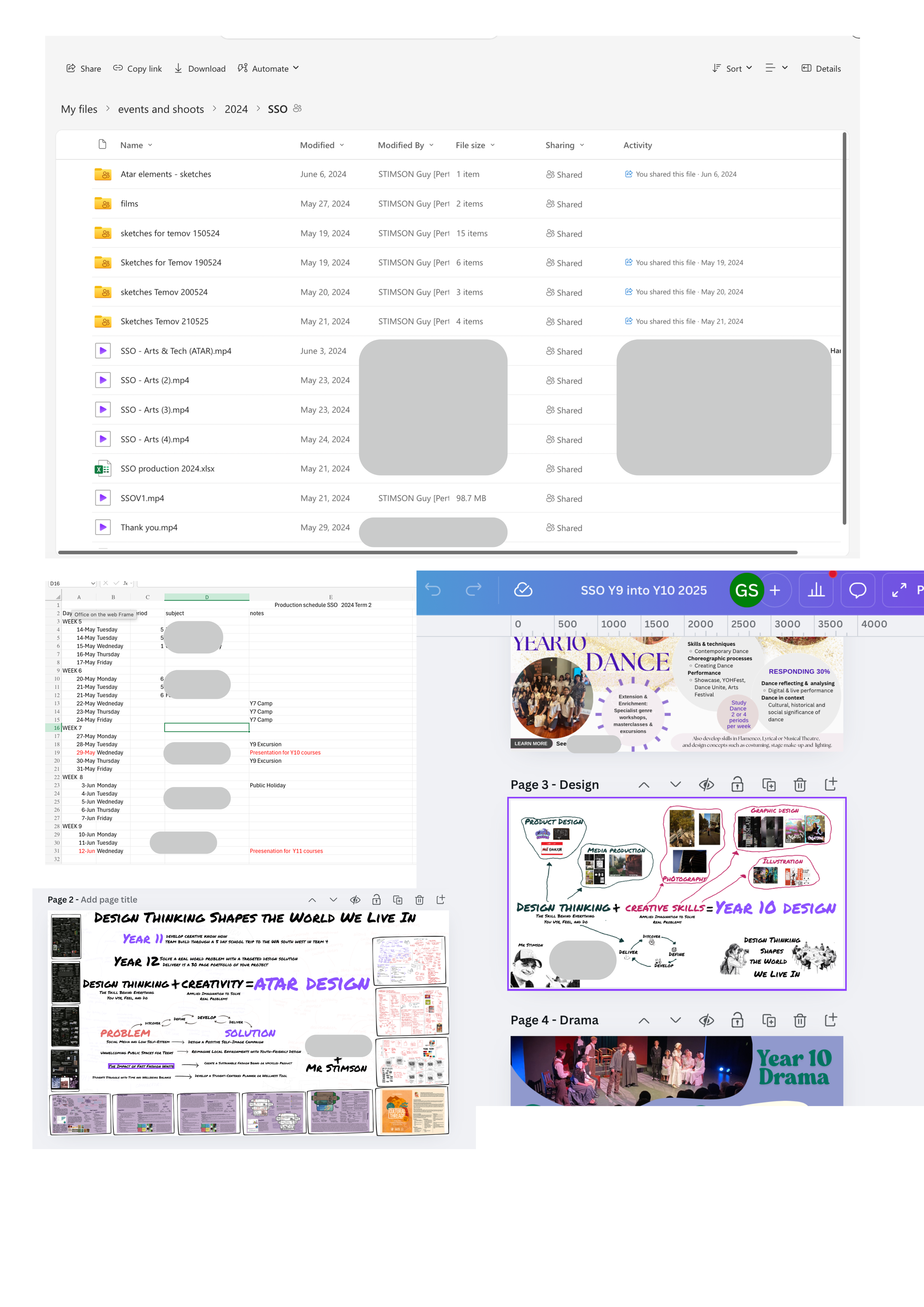
5.4 Interpreting Student Data to Inform Subject Selection Design, Learning Area Messaging, and Teaching Practice
The creation of the SSO presentations, learning area videos, and associated communication assets was grounded in extensive analysis of student data gathered across multiple years. My colleague and I examined enrolment patterns, progression rates, assessment performance, student reflections, and feedback collected during critiques and informal learning conversations. This data provided a detailed picture of how students were experiencing the Design pathway from Year 7 to Year 12, where they felt confident, where misconceptions remained, and how their creative and academic development aligned with the demands of ATAR Design.
The handwritten planning notes, email threads, production schedules, sketches, and iterative drafts shown in this evidence set reveal how we used this data to sharpen the clarity and accuracy of the information presented to Year 9 and Year 10 cohorts. We were intentional about ensuring that the videos and presentations communicated expectations based on real student outcomes rather than assumptions. Patterns in prior student performance helped us highlight essential skills, clarify workload and pacing, and refine the way we explained the progression from lower-school exploratory learning to senior-school sustained project work.
Additionally, data drawn from class-based assessments and year-level trends guided our decisions about which exemplars to include in the presentations—ensuring students saw authentic representations of success, challenge, and growth at each stage of the pathway. These insights directly informed the revisions of the learning area message, the redesign of the SSO experience, and the scaffolded support provided to students making subject choices.
By analysing and applying student data to evaluate learner understanding, refine course messaging, and modify how we support student decision-making, this work exemplifies AITSL 5.4. It demonstrates a systematic, collaborative approach to using evidence to strengthen teaching practice, enhance curriculum transparency, and improve student outcomes across multiple year groups.
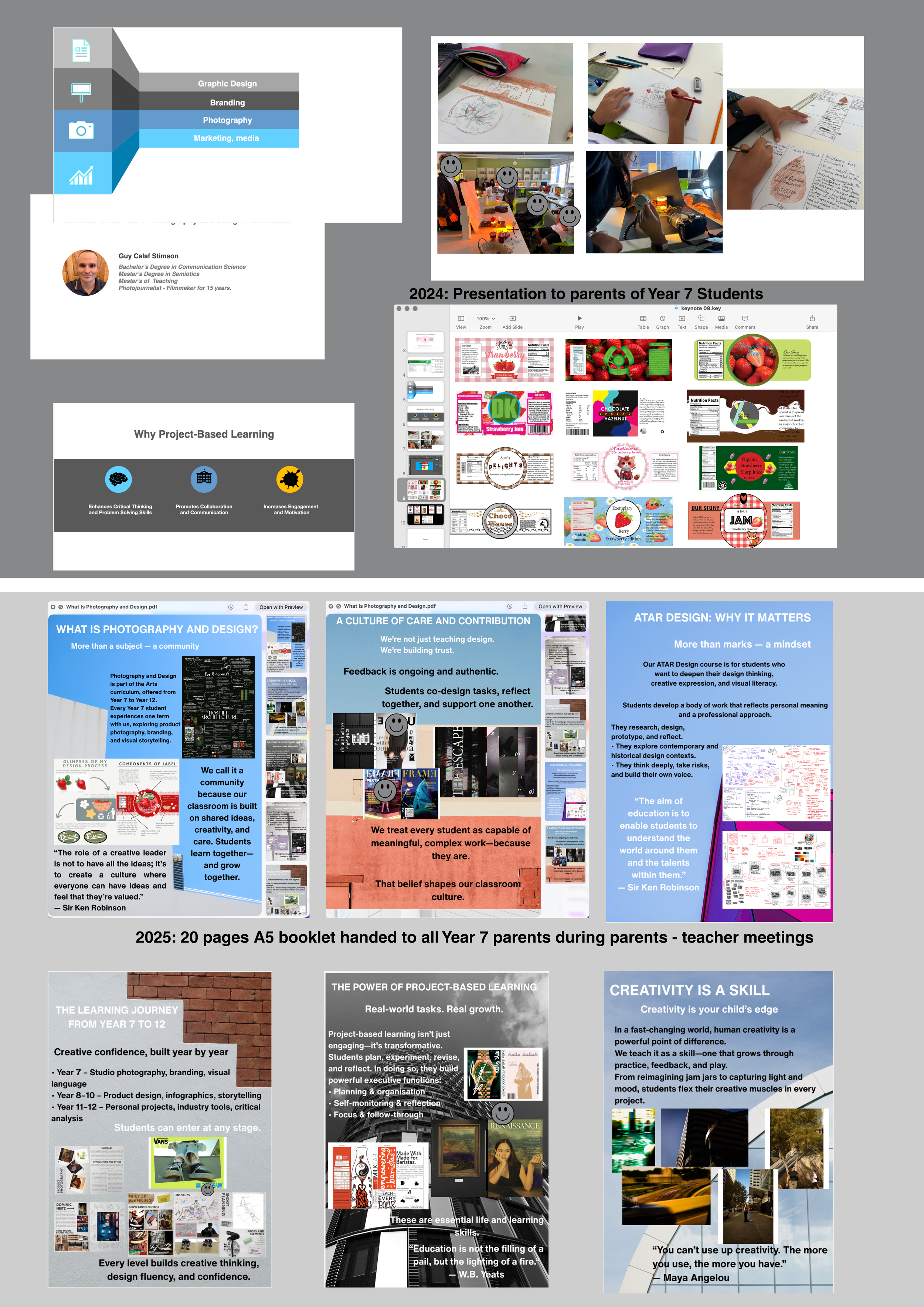
7.3 Engaging Parents Through Clear, Evolving Communication About the Photography & Design Program
This evidence set shows how I have developed two major parent-facing communication assets across consecutive years to strengthen understanding, trust, and collaboration between families and the Photography & Design learning community at Perth Modern School. In 2024, I created and delivered a live presentation to two rotating groups of Year 7 parents, introducing our program through a clear and respectful narrative centred on project-based learning, design thinking, and the culture of care that underpins our classroom practices. The presentation helped parents understand not only what their children would learn, but why our pedagogical approach matters. It opened space for questions, created immediate rapport, and established a foundation for collaborative support of each student’s learning and wellbeing.
In 2025, I refined and deepened this work by producing a comprehensive 20-page A5 booklet, distributed to all Year 7 parents and used in more than 35 individual parent–teacher meetings. This booklet communicated the program’s values, expectations, key learning journey, and the role of design thinking in developing creative competence and agency. It was designed to be sensitive, accessible, and transparent—providing families with a clear picture of how their children would grow through the course and how they could support that growth at home. The asset also ensured equity: every family, regardless of attendance at live events, had access to the same high-quality information.
Together, these communication tools demonstrate responsive, respectful, and proactive engagement with parents (AITSL 7.3). They show my commitment to creating consistent, thoughtful channels that help families understand our pedagogical priorities, feel welcomed into the learning community, and participate in their children’s progress. By evolving these assets year to year, I strengthened both the clarity of information and the quality of relationships between the Photography & Design program and its parent community.