Redesign of Year 11 ATAR Design Course
AITSL Focus Areas: Content selection and organisation (2.2); Plan, structure and sequence learning programs (3.2); Engage in professional learning and improve practice (6.2) Curriculum, assessment and reporting (2.3) Literacy and numeracy strategies (2.5) Make consistent and comparable judgements (5.3) Identify and plan professional learning needs (6.1) Engage with professional teaching networks and broader communities (7.4)
SITUATION
In 2023, the Western Australian ATAR Design course underwent significant structural and content changes. The first cohort was tested under this new syllabus in 2024, marking a critical shift in both assessment expectations and pedagogical direction. In 2025, I began teaching Year 11 ATAR Design for the first time. I was fortunate to be mentored by my subject partner, a teacher with over 25 years of experience in the field, including five consecutive Design Exhibition Awards—Western Australia’s highest recognition of student achievement in this subject.
Through collaborative planning and informal mentoring conversations, I developed a clear understanding that Year 11 is not just a foundation year but a crucial formative period to build the skills that will be assessed in Year 12’s major work: a cohesive 30-panel A3 digital portfolio presented in landscape format.
ACTION
Drawing from my mentor’s experience, current curriculum documents, and educational research on design pedagogy, I implemented two major strategies aimed at improving student outcomes:
1. Iterative Workflow Over Presentation-Driven Design
Rather than focusing on polished outcomes from the start, I encourage students to work "rough and ready":
Panels begin as handwritten notes, digital sketches, and informal layout experiments.
Students work in the applications of their choice (e.g., Procreate, Miro, Figma, Illustrator) to promote fluency and confidence with tools.
This approach draws from Donald Schön’s concept of the Reflective Practitioner and the iterative cycle of "design–evaluate–redesign" as a form of cognitive apprenticeship.
“Design is iterative. You do something, test it, and do it again.” — Paul Rand
2. Developing the Two-Layer Visual Communication System
In line with dual coding theory and visual literacy frameworks, I introduced a two-layer design strategy to help students structure their future Year 12 portfolios:
Top Layer: Immediate, visually dominant content—a concise visual summary that allows the viewer to understand the panel’s purpose without delving deeper.
Bottom Layer: A more detailed narrative—supporting visuals, research, and rationale for curious or evaluative viewers to explore.
This approach prepares students to communicate at two cognitive levels: quickly, for accessibility and narrative coherence; deeply, for analytical engagement. It reduces cognitive overload while increasing clarity and flow across the 30-panel portfolio.
“Design is the silent ambassador of your brand.” — Paul Rand
“Good design is as little design as possible.” — Dieter Rams
To help students build this skill:
We deconstruct strong design folios using metacognitive questioning (What is the top layer communicating? What’s the invitation to the second layer?).
We practice reworking panels from single-layer to dual-layer designs, using visual hierarchy, Gestalt principles, and semiotic strategies.
OUTCOME
By the end of Term 2:
Students had begun embracing iteration as a strength rather than a flaw, showing more willingness to experiment and revise their ideas.
Their comfort with layout software and design conventions improved notably, especially in how they structure information visually.
Students now articulate their projects with clearer intent, beginning to treat their panels as part of a larger narrative arc, not just individual snapshots.
Several Year 11 students have informally remarked that the approach feels “less stressful” and “more real,” aligning with authentic design workflows used in industry.
I have laid the groundwork for a smooth transition into Year 12, where this two-layer presentation method will help them manage the complexity and expectations of the final major work.
Framework Links
Dual Coding Theory (Paivio): Supports using both visual and verbal information in layered communication.
Constructivist Pedagogy: Encourages students to construct meaning iteratively through trial, error, and reflection.
Cognitive Load Theory (Sweller): Justifies the separation of information into layers to support comprehension and retention.
Design Thinking: Emphasises ideation, prototyping, feedback, and iteration as ongoing practices.
Annotated Evidence
2.2 – Content Selection and Organisation
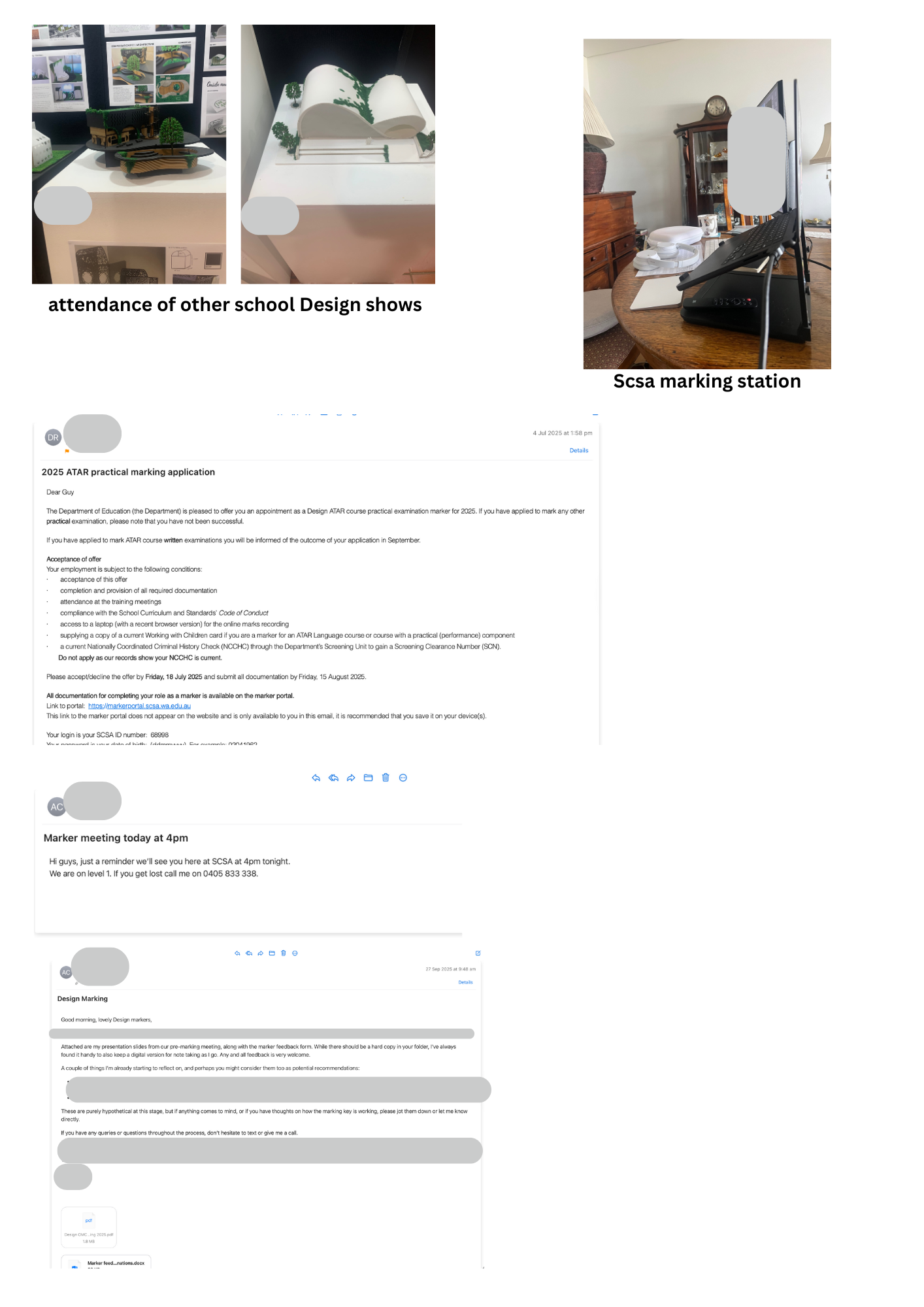
These images document how I strengthened my organisation and sequencing of the Year 11 ATAR Design course by engaging directly with high-level exemplars and statewide assessment processes. Visiting design exhibitions at other schools and universities allowed me to study how successful programs structure ideation, prototyping, and final communication. The photos of my SCSA marking station and the accompanying emails show my formal involvement as a practical examiner, where I evaluated a wide range of Year 12 folios and collaborated with senior markers.
Through analysing external student work and working within the SCSA marking framework, I refined the order in which I introduce design skills, ensuring Year 11 students develop the foundations required for the 30-panel portfolio. This experience directly informed the way I organise content—from integrating physical prototyping earlier, to teaching iterative workflows explicitly, to structuring visual communication as a layered system. The result is a more coherent, better-sequenced learning program aligned to authentic standards across the state.
6.2 – Engage in professional learning and improve practice
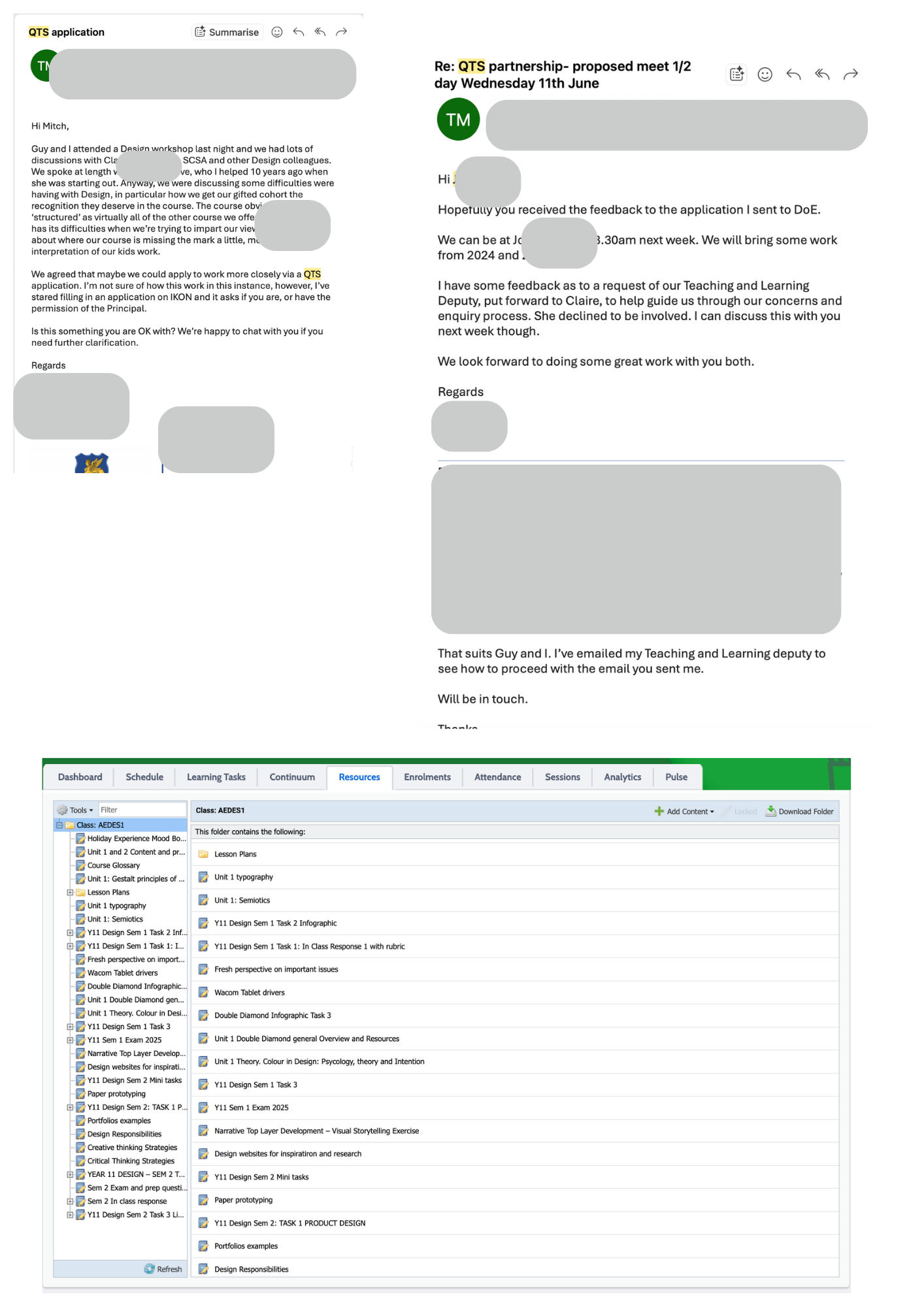
The images document a sustained professional learning partnership between Perth Modern School and John Curtin College of the Arts through the QTS network. The email exchanges show the coordination of a full-day collaborative workshop where my colleague and I met with two experienced ATAR Design teachers to analyse practice across both schools. During this session, we compared Year 11 and 12 folios, examined assessment design under the revised ATAR syllabus, and aligned our expectations using insights from an SCSA-led PD earlier in the year.
These discussions strengthened our shared understanding of the new course demands—particularly the need for deeper ideation, physical prototyping, and clearer intention-setting within student portfolios. The professional dialogue also helped us refine task sequencing and clarify the visual communication expectations leading into the 30-panel ATAR folio.
The final screenshot of my Compass resources folder demonstrates how this professional learning translated directly into my teaching practice. The extensive collection of unit plans, literacy scaffolds, Double Diamond resources, exemplars, portfolio guides, and assessment materials reflects the depth of content curation and ongoing refinement that emerged from this inter-school collaboration. Through this targeted learning, I strengthened my curriculum knowledge, improved my assessment design, and enhanced the resource ecosystem available to my students.
2.5 — Literacy and Numeracy Strategies
The images demonstrate the ways I have strengthened my own disciplinary literacy through active engagement with SCSA as an ATAR Design practical examiner and through visits to other schools’ Design exhibitions. By examining a wide range of high-performing student folios, prototypes, written rationales and design justifications, I developed a deeper understanding of the specific literacy demands of senior secondary Design—specialised vocabulary, multimodal communication, layered annotation, and evaluative writing. This directly informed how I teach students to structure written design rationales, articulate design intention, and sequence annotated panels, improving the clarity and accuracy of their literacy practices in the discipline.
My participation in SCSA marking meetings further refined my knowledge of the numeracy requirements embedded in ATAR Design—such as scale, proportion, measurement, spatial reasoning, and layout grid systems. These professional insights enabled me to explicitly teach numeracy-based design strategies in class, including visual hierarchy, alignment ratios, prototyping measurements, and scale drawings.
Together, these experiences strengthened my ability to apply effective literacy and numeracy teaching strategies within Design, ensuring students produce work that is not only creative but communicates clearly, precisely, and in alignment with senior curriculum expectations.
5.3 — Make consistent and comparable judgements
The images demonstrate my active participation in assessment moderation across multiple professional contexts, ensuring my judgements of student learning are consistent with school-wide and state-wide expectations. Through the QTS partnership sessions with John Curtin College of the Arts, my colleague and I engaged in structured comparison of student design folios, prototypes, annotations, and panel sequencing—aligning our interpretations of standards and refining our shared assessment language. At Perth Modern School, I worked closely with my mentor to map Year 11 and 12 Design work against SCSA assessment criteria, using exemplars and our collective experience to calibrate expectations and ensure comparability across classes. My involvement in SCSA-led professional development and examination briefings further strengthened my understanding of statewide marking conventions, enabling me to apply these principles to my own assessments and to validate them through collegial discussion. Together, these processes demonstrate my ability to participate in and apply moderation activities that result in accurate, defendable, and comparable judgements of student achievement.
6.1 — Identify and plan professional learning needs
The email exchanges shown illustrate how my ATAR Design mentor and I used the Australian Professional Standards for Teachers—specifically Standards 2, 3, 5, and 6—to identify gaps in our shared practice and plan targeted professional learning through a QTS partnership with John Curtin College of the Arts. Under the guidance of our Associate Principal for Teaching and Learning, we established the QTS opportunity as a structured forum to examine and improve our assessment and programming processes. Together, we mapped our students’ existing Year 11 and 12 portfolios against the limited SCSA exemplar panels provided during the Bob Hawke College professional development session with the SCSA subject coordinator. This comparative analysis highlighted areas where we needed deeper alignment with curriculum intent, assessment expectations, and contemporary design pedagogy. The images demonstrate our collaborative planning, communication with partner schools, and systematic organisation of course resources—evidence of a purposeful, standards-informed approach to planning our own professional learning in order to strengthen classroom practice and improve student outcomes.
7.4 — Engage with professional teaching networks and broader communities
The QTS partnership shown through these emails demonstrates how I actively engaged in and helped establish a professional learning network that extended beyond Perth Modern School, creating a structured forum for shared expertise in ATAR Design. Through this collaboration with John Curtin College of the Arts—supported by our Associate Principal for Teaching and Learning—my mentor and I contributed to a community of practice that broadened our pedagogical knowledge, deepened assessment alignment, and strengthened curriculum integrity across both schools. This network became a catalyst for further professional engagement: the insights and comparative analysis developed during QTS directly informed later professional development sessions I delivered, including my ATOMWA presentation, where I mapped ATAR Design back into middle school programs using the Creative Fitness framework. These opportunities arose because QTS positioned me as an active contributor to external professional communities, enabling me not only to refine my own practice but to lead and support colleagues across Western Australia in strengthening design education.
3.2 – Plan, Structure and Sequence Learning Programs
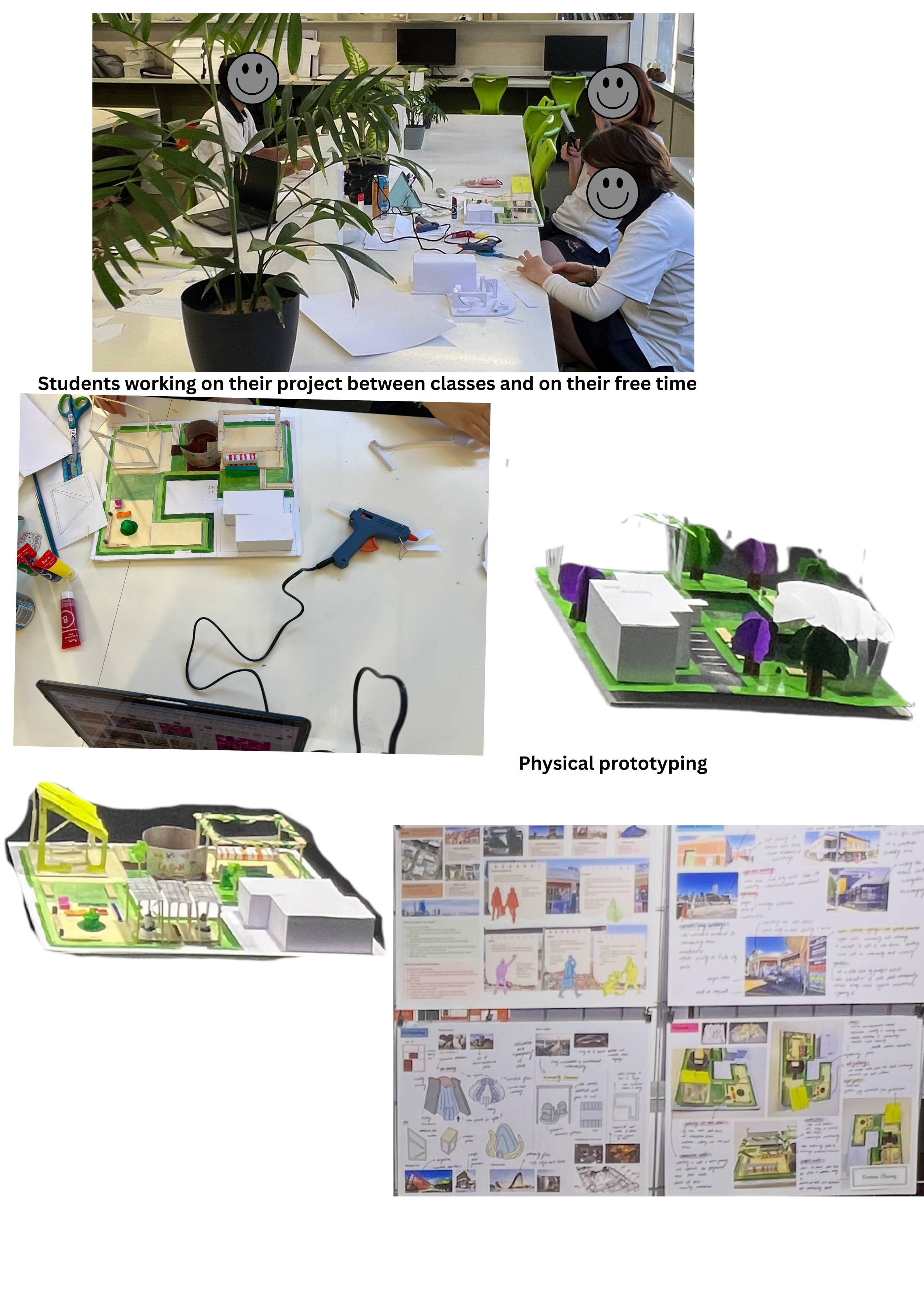
The images illustrate how I design and structure the Year 11 ATAR Design program to build a coherent, rigorous learning sequence that mirrors authentic industry practice. The first set shows students working voluntarily on their design projects between classes and in their own time. This behaviour is a direct outcome of a structured workflow that emphasises autonomy, iteration, and purposeful planning. Students are provided with a clear long-term project arc and weekly check-ins, allowing them to self-pace while remaining aligned to key milestones.
The photos of physical prototyping sessions—students cutting, assembling, testing, and refining three-dimensional models—demonstrate the deliberate embedding of prototyping as a central pedagogical strategy. These prototypes form part of a planned sequence that moves students from research → ideation → low-fidelity prototyping → mid-fidelity testing → refinement → final proposal. This structure supports deeper engagement and mirrors expectations from SCSA and the broader design industry.
The final panel of images includes double-page folio spreads demonstrating how students synthesise conceptual development, precedents, user research, and prototyping into coherent visual narratives. The consistency in layout, iteration cycles, and justification reflects how the program scaffolds students’ understanding of design methodology across terms.
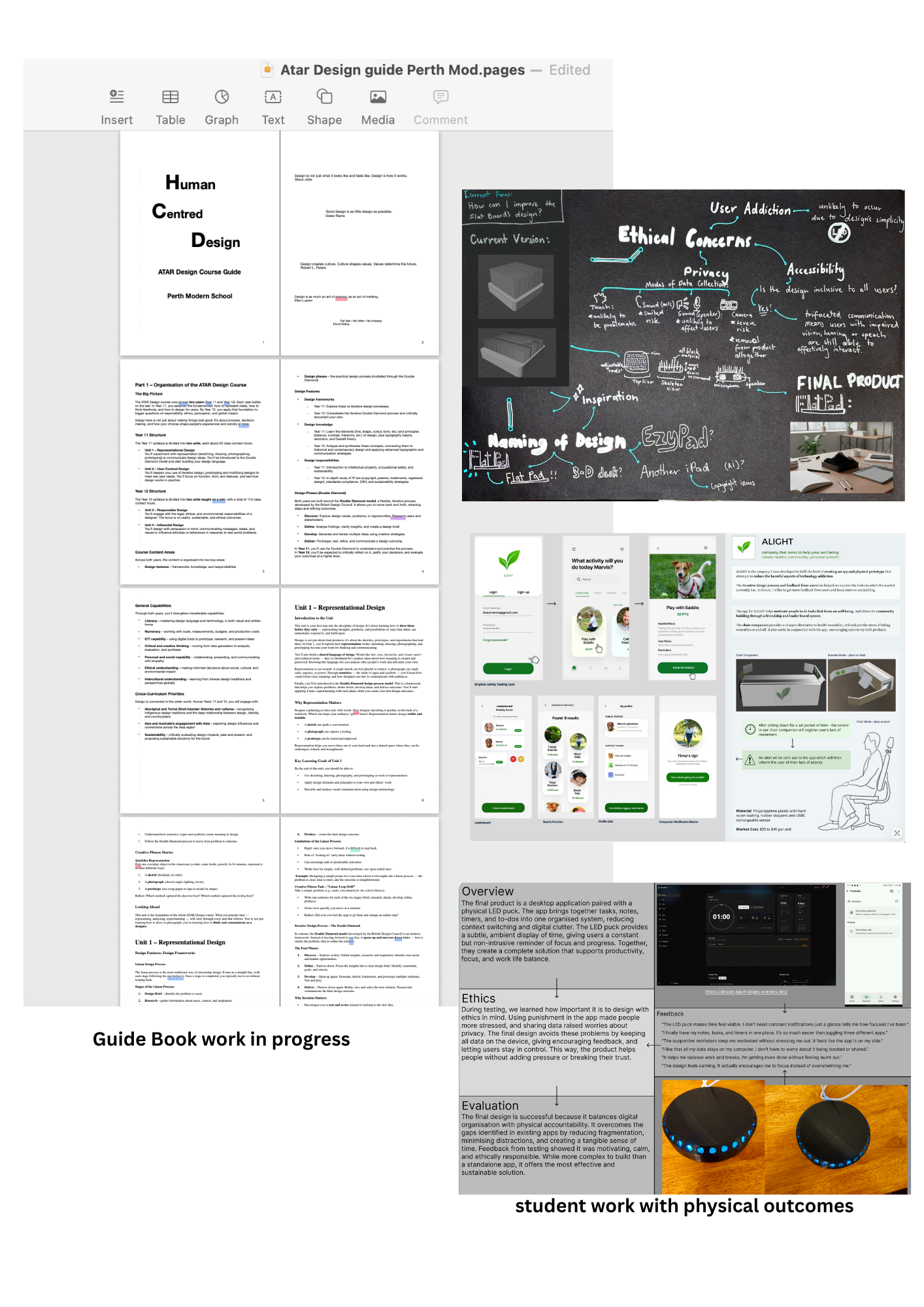
The last set of images shows my ATAR Design Guidebook, a comprehensive resource I am writing for full implementation in 2026. ATAR Design is one of the few WACE subjects without a textbook; therefore, I am developing a 150-page guide that structures the entire two-year learning pathway. The images show chapters on human-centred design, representational design, ethical considerations, UI design, prototyping techniques, folio conventions, and SCASA requirements. This guidebook ensures that all students—regardless of background knowledge—enter the course with a clear roadmap and shared language.
Taken together, these images evidence a deliberate sequencing of learning that:
Builds foundational design thinking skills
Introduces prototyping and user-centred methods through structured practical tasks
Develops conceptual depth and technical skill across successive units
Prepares students for the cognitive and organisational demands of the Year 12 30-panel portfolio
2.3 - Curriculum, assessment and reporting
The images demonstrate how I used curriculum, assessment and reporting knowledge to design learning sequences and teaching programs that precisely align Year 11 ATAR Design with SCSA’s revised syllabus and assessment requirements. In preparation for the unified Design course proposed by SCSA from 2024 onward, I conducted a detailed analysis of the curriculum changes and mapped them across Years 7–10 to ensure a coherent developmental trajectory into ATAR. This analysis directly informed the creation of a 150-page ATAR Design Guidebook, shown in the images, which reorganises SCSA content into clear, progressive learning sequences covering representational design, semiotics, design principles, documentation conventions, prototyping methods, and evaluation processes. The student work samples and architectural prototypes shown illustrate how I translated assessment criteria into explicit, scaffolded tasks that build representational, conceptual, and practical design capabilities. By integrating physical prototyping, folio development, and iterative testing, I ensured that teaching, learning and assessment were tightly aligned with SCSA’s expectations for practical originality, documentation transparency, and evaluative depth. This curriculum-aligned structure provides students with continuity from Years 7–10 and prepares them for the rigour, reporting requirements, and genre conventions of Year 12 ATAR Design.