Visual Storytelling to Represent and Communicate Perth Modern School’s Identity
AITSL Focus Areas: Use effective classroom communication to support student participation and agency (3.5) Students with diverse linguistic, cultural, religious and socioeconomic backgrounds (1.3); Strategies for teaching Aboriginal and Torres Strait Islander students (1.4); Understand and respect Aboriginal and Torres Strait Islander people to promote reconciliation between Indigenous and non-Indigenous Australians (2.4); Engage parents/carers in the educative process (3.7); Maintain student safety (4.4)
Situation
Since 2022, I have actively contributed to shaping how Perth Modern School communicates its values, achievements, and learning culture through multi-thematic and purpose-driven visual media. Beginning with video projects that amplified student voice, I quickly became involved in broader storytelling initiatives, including the creation of assets for the school review, Year 12 presentations, competitions like Opus, and most recently, the visual rollout of the school’s new values as articulated in the 2025 Business Plan.
I have had the privilege of not only documenting, but co-constructing the evolving story of the school as a place of academic rigour, inclusivity, and excellence in public education. My role as a teacher—and as a former photojournalist and branding expert—uniquely positions me to blend narrative insight with lived experience to create authentic and high-quality representations of Perth Modern's identity.
Action
Produced a range of strategic video and social media assets that serve both internal and external communication goals, helping the school maintain strong alignment with its identity and community expectations.
Collaborated with leadership and colleagues to ensure that media outputs aligned with the school’s educational priorities and cultural values.
Took a lead role in the Curtin University research project, commissioned by the WA Department of Education, to develop the Centre for Excellence in the Explicit Teaching of Literacy. As part of this team, I planned and executed visual assets that clearly communicated the project’s aims, implementation, and success stories across participating schools.
Applied design thinking principles to the production process, ensuring each asset addressed a core communication purpose—such as clarity, connection, celebration, or explanation.
Participated in community events and special projects to visually represent Perth Modern’s connection to its broader community of practice.
Outcome
Strengthened whole-school engagement and community identity through the development of compelling, professional-quality visual narratives.
Supported the school’s strategic communication objectives by helping stakeholders—students, staff, parents, and the public—understand the school’s values and learning environment in a coherent, accessible way.
Built internal capacity for effective school communication by mentoring students and colleagues in the planning and execution of storytelling-based media.
Developed an archive of re-usable, purpose-fit visual resources that can be shared across platforms, creating a consistent and values-led voice for the school.
Deepened my understanding of how to ethically and strategically communicate in educational contexts, especially when representing public institutions, diverse communities, and student voice.
Future Directions
Moving forward, I hope to further support Perth Modern School’s communication by:
Creating a dedicated podcasting platform to share conversations with students, staff, and alumni about learning, leadership, and impact.
Using social media platforms in more community-facing ways—showcasing Perth Modern as a public school that leads with creativity, academic depth, and a strong ethical culture.
Contributing to the school’s ongoing digital strategy and upskilling others in ethical storytelling, inclusive representation, and platform-specific content creation.
Research and Framing
Effective school communication is increasingly seen as central to building trust, transparency, and meaningful engagement between schools and their communities (Epstein, 2011; Baker et al., 2021). Research shows that authentic, multimedia storytelling can foster stronger emotional connections with families, help articulate a school’s vision, and demystify the learning journey (Westmoreland et al., 2009). Additionally, visual media can reduce barriers to participation for parents from diverse linguistic or cultural backgrounds (Goodall, 2016).
By applying these insights through my professional background and ongoing practice, I aim to ensure Perth Modern’s voice is not only heard—but truly seen and felt—across its community and beyond
Annotated Evidence
3.5 – Student Communication Focus
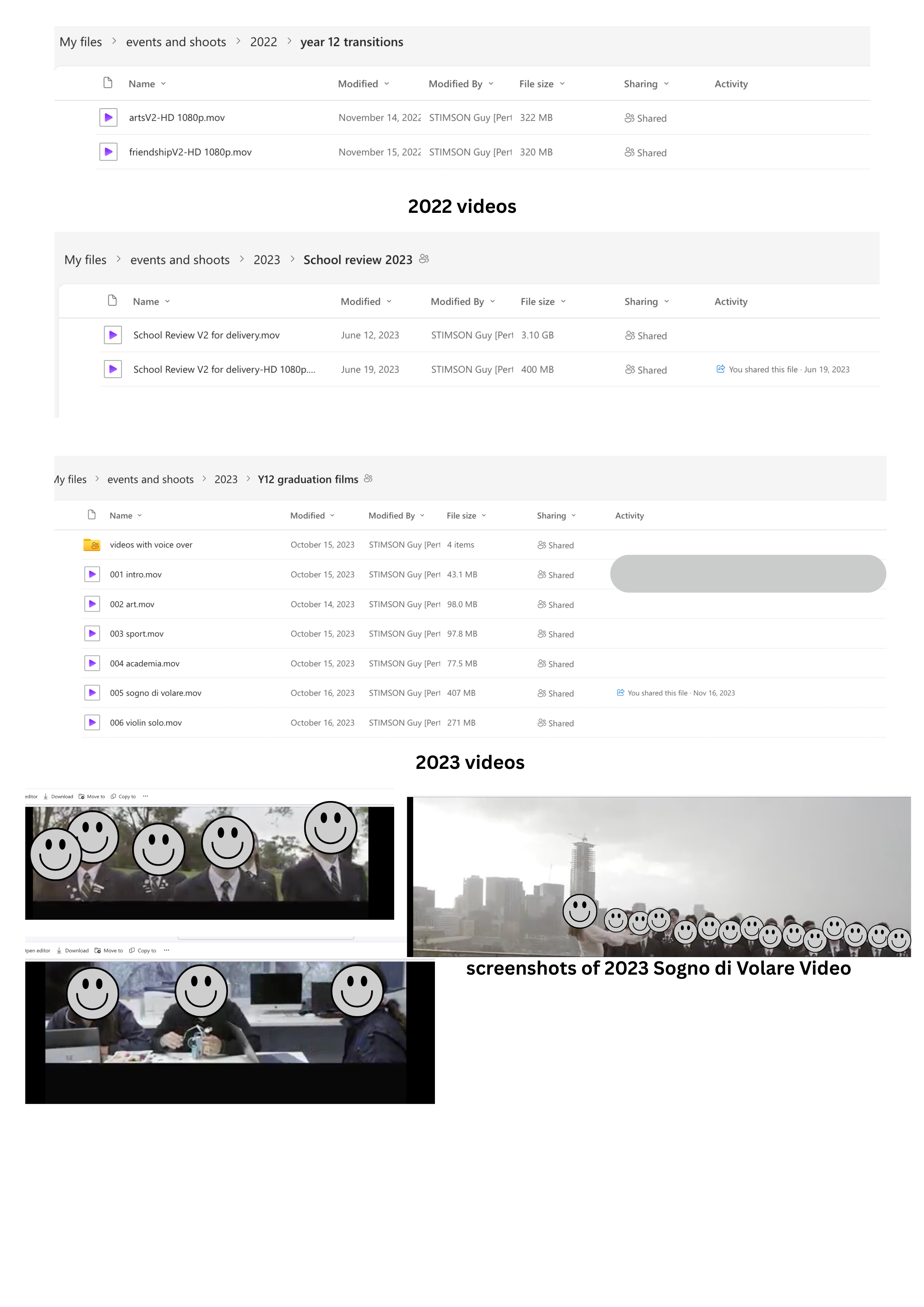
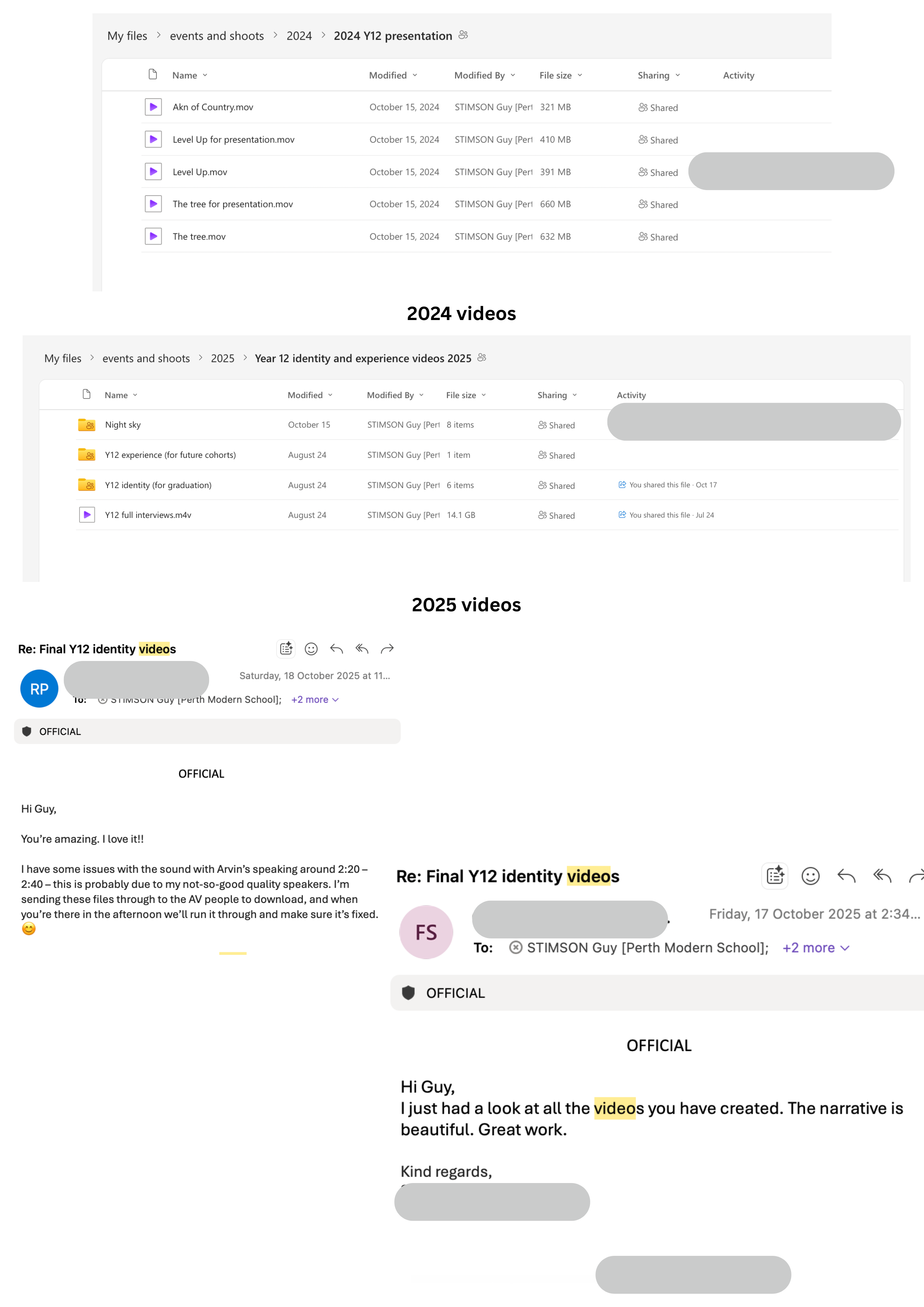
The images document my sustained use of multimodal communication to engage students in high-stakes, authentic storytelling projects that represent our school’s identity. Across the four years shown (2022–2025), I worked closely with students to plan, film, refine, and produce major narrative videos that were showcased at Year 12 Graduations, School Reviews, and community events.
These folder archives, file structures, and production stills demonstrate how I communicated expectations, processes, and creative intentions clearly and consistently. Students were guided through complex, industry-style workflows—storyboarding, interviewing, performing to camera, reviewing drafts, and collaborating on revisions—using a combination of verbal explanation, modelling, visual cues, and iterative feedback conversations.
My communication strategies are evident in the scale and quality of the work:
– Students appear in interview sequences, scripted scenes, collaborative outdoor shoots, and classroom-based storytelling, showing high levels of comfort, agency, and clarity about their role in the narrative.
– The consistency of participation across multiple year groups highlights the trust and rapport established through ongoing, explicit communication.
– Students contribute confidently both behind and in front of the camera, demonstrating their understanding of creative intent, audience, and message—skills developed through guided discussion, rehearsal, and reflective dialogue.
Email excerpts from executive staff acknowledge the clarity and emotional impact of these videos, evidence that students understood not only what they were communicating but why. Their ability to articulate school values, personal stories, and cohort identity stems from communication structures I deliberately built into the process: modelling tone, scaffolding responses, using non-verbal cues for interview pacing, and practising audience-aware delivery.
These visual products represent thousands of hours of collaborative communication between myself and students, where meaning was co-constructed through:
– iterative feedback loops
– guided rehearsal
– shared visual analysis
– reflective questioning
– scaffolded narrative development
Through these processes, I supported students’ understanding, participation, and achievement—directly aligned with AITSL 3.5, which emphasises effective verbal and non-verbal communication to engage learners.
Students were not passive subjects; they became co-authors of the school’s identity. Their confident presence on screen, their narrative ownership, and their ease in expressing complex ideas visually and verbally all demonstrate the effectiveness of my communication practice.
1.3 — Representing & Responding to Student Diversity Through Visual Storytelling
Across four years of whole-school media production, I have intentionally designed visual storytelling practices that recognise and respond to the diverse linguistic, cultural, religious, and socioeconomic identities of Perth Modern’s students. When producing the Year 12 transition films, identity videos, school review media, and values-aligned storytelling assets, I ensured that representation was inclusive, accurate, and sensitive to the varied backgrounds of our students. This included adapting filming approaches to accommodate student comfort and cultural expectations, ensuring opt-in participation, using language and narrative framing that did not privilege particular groups, and actively foregrounding student voice from across the cohort.
Regular collaboration with Associate Principals and student leaders acted as a moderation process to verify that portrayals were respectful, non-tokenistic, and reflective of the school’s real demographic. Across each project cycle, I refined the narrative and visual choices based on feedback from students with different cultural and linguistic profiles, ensuring they recognised themselves in the final products. Through this work, I demonstrated the ability to design teaching and communication strategies that draw on students’ diverse strengths and needs, making the school’s public storytelling more inclusive, equitable, and community-responsive.
1.4 — Embedding Respectful Representation of Aboriginal and Torres Strait Islander Perspectives in School Storytelling
Across the 2022–2025 whole-school visual storytelling projects, I ensured that the representation of Aboriginal and Torres Strait Islander students, cultures, and community perspectives was handled with accuracy, cultural awareness, and respect. Whether producing the Year 12 graduation narratives, the annual transition films, community-facing review assets, or the 2025 values rollout videos, I embedded a consistent practice of consultation, consent, and cultural sensitivity.
Before filming, I adapted scripts, locations, and narrative framing to ensure alignment with the cultural protocols communicated through the school’s Reconciliation Action Plan and guidance provided by Aboriginal staff and community representatives. Participation was always opt-in, with explicit scaffolding around student comfort, identity visibility, and how their story would appear in public contexts. When Aboriginal students contributed, I centred their own words and worldviews, allowing them—not the school, nor myself—to lead the meaning-making of their representation.
I also engaged in professional reading and school-based learning around the impact of culture, Country, identity, and linguistic background on Aboriginal and Torres Strait Islander students’ experiences. This enabled me to refine filming approaches, avoid deficit framing, and design visual narratives that affirmed strength, belonging, and agency.
Through these practices, I demonstrated the ability to design learning and communication strategies that respect cultural identity and diversity, support student wellbeing, and authentically embed Aboriginal perspectives within a contemporary public-school context.
2.4 — Ethical Storytelling to Promote Understanding and Respect for Aboriginal and Torres Strait Islander Histories, Cultures, and Languages
Across the 2022–2025 identity, transition, and cultural narrative videos, I demonstrated a deep commitment to ensuring that representations of Aboriginal and Torres Strait Islander students, cultures, and perspectives were accurate, respectful, and aligned with reconciliation principles. As part of this process, I worked closely with my Associate Principal, who guided elements of cultural framing, narrative emphasis, and alignment with the school’s reconciliation commitments. Together, we carefully curated content to ensure that each video honoured the histories, languages, and identities of Aboriginal and Torres Strait Islander peoples.
In planning and filming, I incorporated explicit opportunities for students and staff to reflect on Perth Modern School’s place on Whadjuk Noongar Country, foregrounding belonging, culture, and connection to place. Students were invited to speak in their own voice, with autonomy over what they shared and how they wished their identities to be represented. When Aboriginal students participated, I ensured their cultural perspectives were not extracted or tokenised, but integrated as part of a broader narrative of school identity, diversity, and shared community.
These videos became catalysts for rich staff discussions about cultural positioning and reconciliation. Their impact led my Associate Principal and me to begin conceptualising a Student Voice 2.0 project—a whole-school video exploring Perth Modern’s evolving cultural stance and its responsibilities as a public school on Aboriginal land. Although this project paused due to my Associate Principal’s departure, the pedagogical and ethical groundwork we laid remains a significant part of my ongoing practice.
Through these processes, I provided structured opportunities for students to deepen their understanding of Aboriginal and Torres Strait Islander cultures and histories, while modelling respectful, reconciliatory storytelling practices for colleagues. These strategies continue to influence how I design learning, media projects, and school-wide narratives that honour the cultural identity of Australia’s First Peoples.
3.7 — Strengthening School–Family Partnerships Through Transparent and Purposeful Visual Communication
Across the 2022–2025 cycle of school identity, transition, and celebration videos, I positioned parents and carers as central participants in the educative process. Working closely with my Associate Principal, I developed a communication approach grounded in the belief that Perth Modern School is a community of practice—one in which families play a vital role in shaping student engagement, school culture, and the shared understanding of our strategic direction.
Each video—whether a Year 12 identity film, a school review narrative, a transition piece, or a Business Plan values rollout—served as a high-impact communication tool that made learning visible for families. Thousands of parents viewed these videos each year through assemblies, digital platforms, and major school events. This provided consistent and accessible insight into school priorities, student learning experiences, and the broader educational philosophy guiding our work.
By using film as a transparent storytelling medium, I created contextually relevant entry points for parents to meaningfully engage with their child’s schooling. Parents could see the rigour of the curriculum, the values shaping school life, and the cultural aspirations articulated in the Business Plan—all represented through the voices and experiences of students themselves.
In developing these assets, I collaborated with colleagues to ensure that each video aligned with school-wide priorities and was appropriate for a diverse parent community, including families new to the school or those less familiar with its programs. The videos also initiated conversations at home: parents reported deeper understanding of the school’s vision and their child’s journey, bridging the gap between school and family learning environments.
Through this work, I established repeatable, high-quality communication processes that actively involve parents and carers in understanding and supporting their children’s experiences at Perth Modern. By positioning families as informed partners, these visual narratives strengthened trust, coherence, and connection between the school and its community.
4.4 — Embedding Safe, Ethical, and Supportive Practices in Creative and Digital Learning Environments
In the Year 10 Multimedia course and across all film-based learning environments I lead, student safety and wellbeing are central to how learning is structured, supervised, and delivered. Because the subject involves practical equipment, digital platforms, collaborative workflows, and public-facing outputs, I implement robust strategies aligned with school policy, curriculum requirements, and legislative obligations.
Physical Safety in Production Environments
Students regularly work with cameras, lighting, tripods, audio equipment, and computer labs. I explicitly teach safe handling procedures, model correct setup and storage of equipment, and supervise all production activities to ensure compliance with school safety protocols. Before any filming begins, students complete risk-aware planning through pre-production documents, including:
– Location safety considerations
– Supervision protocols
– Consent and filming guidelines
– Contingency planning for movement around the school
This structured approach builds student competence while ensuring wellbeing in all practical sessions.
Digital Safety, Privacy, and Ethical Practices
Because the course culminates in digital artefacts—animations, films, and portfolios—I teach responsible ICT use, ethical storytelling, and safe digital publication practices. Students learn:
– How to work within the school’s ICT Acceptable Use Agreement
– How to store and manage footage safely
– When consent is required for recording others
– How to avoid including identifying information without permission
– How to protect themselves and peers when producing or sharing content
These conversations are embedded into every stage of the multimedia workflow, normalising ethical decision-making.
Creating Predictable, Supportive Classroom Routines
My classroom routines prioritise psychological safety alongside physical safety. Clear expectations, structured check-ins, visible timelines, and transparent workflows help reduce stress in a cognitively demanding course. Regular conferencing provides opportunities to raise concerns early, and I make adjustments when students show signs of overwhelm—aligning practice with wellbeing policy and child-safe principles.
Collaborative Implementation with Leadership and Colleagues
I work closely with my Head of Learning Area and Associate Principal when developing major projects, ensuring all processes align with system requirements. When coordinating Year 12 graduation films, school identity videos, or cross-department initiatives, I follow established safety and approval pathways. This guarantees that all student involvement meets policy expectations, including privacy legislation, workplace safety procedures, and duty-of-care guidelines.
Evaluation and Ongoing Improvement
After each major project, I review safety processes and student feedback to refine practice. Adjustments have included:
– Clearer storage protocols for media files
– More structured supervision zones during filming
– Enhanced guidance on digital ethics and cultural sensitivity
– Improved workflows to reduce unnecessary student stress during production phases
These refinements ensure that safety practices continue to evolve in alignment with school, system, and legislative requirements.
Through this integrated approach—combining practical safety, digital ethics, wellbeing-centred routines, and policy alignment—I ensure that creative learning occurs in an environment where students are protected, supported, and empowered to produce their best work.